CNC turning services are precision machining solutions that use Computer Numerical Control(CNC)lathes to manufacture cylindrical and rotational parts with high accuracy and consistency.In the CNC turning process,a workpiece is rotated at high speed while cutting tools remove material from the surface to create the desired shape,size,and specifications.
Compared with traditional manual turning,CNC turning provides improved accuracy,repeatability,and production efficiency,making it widely used for industries such as automotive,aerospace,medical equipment,electronics,and industrial machinery.
Professional CNC turning manufacturers can produce both simple and complex custom parts based on customer drawings,CAD files,or specific requirements.
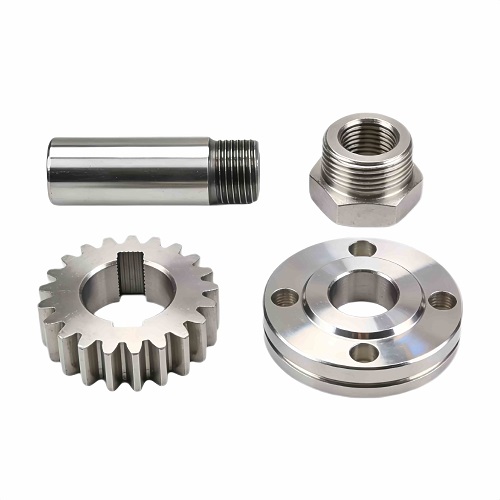
How Does CNC Turning Work?
The CNC turning process involves several key steps:
1.CAD Design and Programming
The process begins with a 3D model or engineering drawing created using CAD software.Engineers convert the design into CNC programming instructions(G-code),which control the movement of the machine tools.
2.Workpiece Setup
The raw material,usually a metal bar or plastic rod,is securely mounted into the CNC lathe chuck.Proper alignment ensures machining accuracy and stability.
3.Material Cutting
During machining,the workpiece rotates while cutting tools move along different axes to remove excess material.The CNC system automatically controls:
Cutting speed
Feed rate
Tool movement
Machining depth
This allows the production of precise components with tight tolerances.
4.Finishing and Inspection
After turning,parts may undergo additional processes such as:
Drilling
Threading
Knurling
Surface finishing
Heat treatment
Quality inspections are performed using measuring equipment such as calipers,micrometers,and CMM machines to ensure the parts meet required specifications.
CNC turning is mainly used for manufacturing round or cylindrical components,including:
A reliable custom CNC turning service provider can manufacture prototypes,small batches,and high-volume production parts.
What Materials Can Be Used for CNC Turning?
CNC turning services support a wide range of materials,including metals and engineering plastics.
Common Metal Materials:
Aluminum
Stainless Steel
Brass
Copper
Excellent thermal and electrical performance
Carbon Steel
Strong and cost-effective for mechanical parts
Plastic Materials:
ABS
Nylon
POM(Delrin)
PTFE
PEEK
Material selection depends on mechanical strength,temperature resistance,corrosion requirements,and application conditions.
What Are the Advantages of CNC Turning Services?
1.High Precision and Accuracy
CNC turning machines can achieve extremely tight tolerances,making them suitable for applications requiring consistent dimensions and reliable performance.
2.Fast Production Efficiency
Computer-controlled machining reduces manual operations and allows continuous production,helping manufacturers shorten lead times.
3.Excellent Repeatability
Once the CNC program is created,the machine can produce thousands of identical parts with consistent quality.
4.Flexible Customization
CNC turning services support custom designs,allowing manufacturers to create unique components according to customer drawings.
5.Reduced Labor Costs
Automation reduces human intervention,improving productivity and lowering manufacturing costs.
CNC Turning Services vs Traditional Turning
| CNC Turning | Traditional Turning |
|---|
| Computer-controlled operation | Manual machine operation |
| Higher precision | Depends on operator skill |
| Suitable for complex designs | Limited complexity |
| High repeatability | More variation between parts |
| Ideal for mass production | Better for small manual jobs |
For modern manufacturing,CNC turning is often preferred because it delivers better efficiency,accuracy,and scalability.
Applications of CNC Turning Services
CNC turning parts are widely used across many industries:
Automotive Industry
Used for producing:
Engine components
Transmission parts
Shafts
Fasteners
Aerospace Industry
Used for:
Medical Industry
Used for:
Electronics Industry
Used for:
Housings
Connectors
Small precision parts
Industrial Equipment
Used for:
Hydraulic components
Machine parts
Automation equipment
How to Choose a Reliable CNC Turning Service Provider?
When selecting a CNC turning manufacturer,buyers should consider:
1.Machining Capability
Check whether the supplier has advanced CNC equipment and can handle required materials,sizes,and tolerances.
2.Quality Control System
A professional supplier should have inspection equipment and quality management processes to ensure consistent output.
3.Manufacturing Experience
Experienced CNC machining suppliers can provide better solutions for complex designs and production challenges.
4.Customization Ability
Choose a manufacturer that supports OEM,prototype development,and customized CNC turning parts.
5.Production Capacity
For large orders,confirm whether the supplier can meet delivery schedules and volume requirements.
FAQ
1.What is the difference between CNC turning and Cnc Milling?
CNC turning rotates the workpiece while cutting tools remove material,mainly creating cylindrical parts.CNC milling keeps the workpiece fixed while rotating cutting tools remove material,making it suitable for more complex shapes.
2.How accurate are CNC turning services?
Precision CNC turning can typically achieve tolerances within±0.01 mm or better,depending on the machine,material,and part design requirements.
3.What industries use CNC turning services?
CNC turning is widely used in automotive,aerospace,medical,electronics,robotics,and industrial equipment manufacturing.
4.Can CNC turning services produce custom parts?
Yes.CNC turning manufacturers can produce customized parts based on CAD drawings,samples,or technical specifications.
5.How long does CNC turning production take?
Production time depends on part complexity,material,quantity,and finishing requirements.Prototype parts may take several days,while mass production requires longer scheduling